

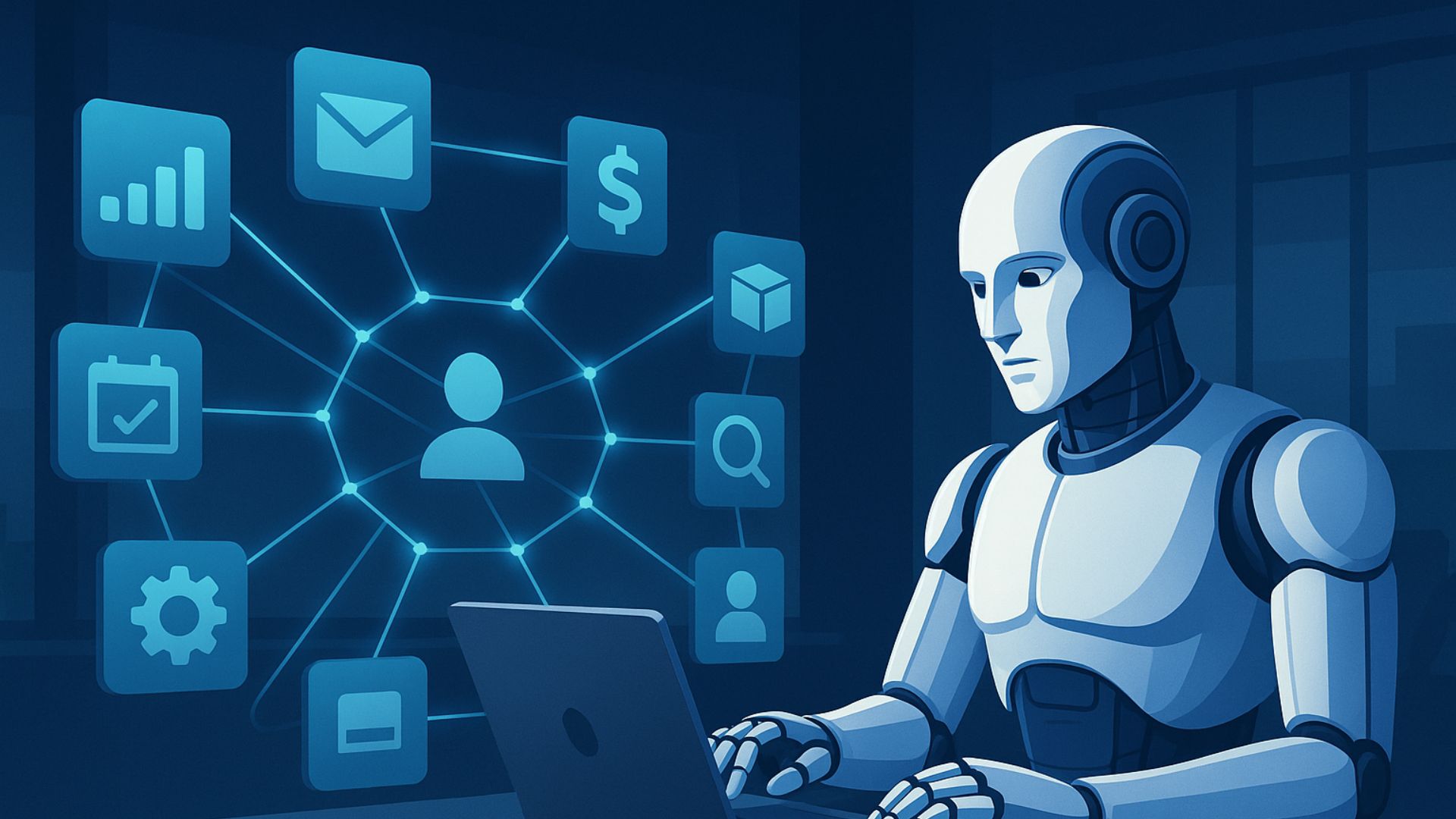
Five years ago, businesses were busy stacking tools—CRMs, email platforms, analytics dashboards, scheduling apps, HR software, finance systems, automation tools.
Today, in 2025, founders are realizing something shocking:
Most of those tools are slowly becoming obsolete.
The future isn’t SaaS.
The future is AI Agents — autonomous systems that think, act, learn, and execute tasks without human micromanagement.
2026 will be the first year where AI Agents officially begin replacing traditional SaaS in mainstream business operations.
This shift won’t be small.
It will be foundational — similar to what smartphones did to computers or what the internet did to print.
Let’s break it down.
What Are AI Agents? (And Why They Beat SaaS Tools)
AI Agents aren’t apps.
They’re not “tools.”
They’re digital employees trained to run entire workflows end to end.
A typical SaaS tool needs:
- Setup
- Integration
- Manual rules
- Human supervision
An AI Agent needs:
- A goal
- Access
- Constraints
And it handles the rest.
Think of a virtual marketer that:
- Writes content
- Designs creatives
- Launches ads
- Optimizes campaigns
- Reports results
- Learns from performance
- Improves automatically
No human setup.
No dashboards.
No “configuring Zapier at 2 AM.”
Just a task → and it gets done.
Why Traditional SaaS Is Becoming Obsolete
1. SaaS tools work in silos
Every tool does one thing.
Businesses use 20–40 tools to run operations.
AI Agents destroy silos.
They can write an email, update CRM, send invoices, analyze analytics, and fix code—all in one pipeline.
2. SaaS requires human babysitting
You still need operators, analysts, or managers.
AI Agents replace operators by acting with human-like reasoning.
3. SaaS stacks are expensive
Every subscription adds friction.
AI Agents are cheaper because they don’t charge per feature.
They charge for intelligence.
4. SaaS cannot learn
Your CRM doesn’t become “smarter” by using it.
AI Agents learn from:
- Past actions
- Company data
- Mistakes
- Outcomes
They evolve.
Real-World Examples: What Agents Will Replace by 2026
1. Marketing Teams → AI Growth Agents
Campaign creation, ad testing, landing page optimization, budget management.
All automated.
2. Sales Teams → AI SDR Agents
Agents will:
- Research leads
- Write personalized outreach
- Follow up
- Book meetings
- Update CRM
Salespeople will only attend high-quality calls.
3. Customer Support → AI Resolution Agents
Not chatbots — agents with full access to systems.
They can:
- Refund
- Update orders
- Solve issues
- Learn from each ticket
4. HR → AI People Ops Agents
Automated:
- Hiring
- Screening
- Policy updates
- Payroll
- Compliance
5. Finance → AI Accounting Agents
Agents that reconcile accounts, classify transactions, detect anomalies, and generate financial statements.
6. Product & Tech → AI DevOps + Coding Agents
Systems that:
- Write code
- Fix bugs
- Deploy features
- Run tests
- Maintain infrastructure
Your engineering team becomes 2×–5× more productive.
What This Means for Founders (The Hard Truth)
1. Businesses with AI Agents scale faster
Speed becomes your competitive edge.
If your competitor automates 40% of operations and you don’t—
they will grow 3× faster at the same cost.
2. Lean teams become the new normal
A team of 5 with AI agents will outperform a team of 50 with traditional SaaS.
This will change:
- Hiring
- Budgeting
- Leadership
- Company structure
3. Founders must become “AI-first operators”
Not coders.
Not ML engineers.
But leaders who understand:
- AI workflows
- Agent orchestration
- Data governance
- Prompt-based operations
Think of it as a new kind of digital literacy.
4. Agencies & service providers will transform
Agencies that rely on manual work will collapse.
Agencies that leverage AI Agents will dominate.
Expect:
- AI content agencies
- AI SDR agencies
- AI operations firms
- AI workflow companies
This is the “Agent Economy.”
How AI Agents Will Change Your Costs
↓ Software costs drop
One AI Agent replaces 10–15 tools.
↓ Labor costs shrink
You automate repetitive tasks.
↑ Output increases
Agents work 24/7.
↑ Margins grow
Lean operations = higher profitability.
This is the first time in history where productivity scales exponentially but costs scale linearly.
The Biggest Risk: Businesses Who Delay Will Lose Market Share
Ignoring AI Agents is not a “wait-and-see” decision.
It is a strategic disadvantage.
Your competitors will use:
- AI sales agents
- AI finance agents
- AI marketing agents
- AI admin agents
They’ll execute faster, cheaper, and more accurately.
The gap created in 2026 will be almost impossible to close by 2027.
This is similar to:
- Brands that ignored social media in 2010
- Businesses that ignored mobile optimization
- Companies that ignored cloud migration
Delaying means losing.
How to Prepare Your Business in 2025
1. Start with 1–2 AI Agents
Pick low-risk, high-volume tasks:
- Support
- Lead generation
- Content
- Admin
2. Clean your data
Garbage in → garbage out.
Your agents are only as smart as your internal data.
3. Build an AI-first workflow
Instead of buying a SaaS tool → assign a task to an agent.
4. Train your team for AI collaboration
Employees don’t get replaced.
Employees who use AI replace those who don’t.
5. Shift budgets from tools to intelligence
Stop thinking in terms of:
- Licenses
- Plugins
- Integrations
Start thinking:
- Agents
- Workflows
- Automation
- Reasoning
The Future of SaaS: Not Dead, But Disrupted
SaaS won’t disappear.
But SaaS without AI Agents will.
2026–2028 will bring a new category of software:
Agentic SaaS
= SaaS + autonomous workflows + reasoning + execution.
Instead of dashboards, it will feel like:
- A conversation
- A digital teammate
- A command center
This is the evolution.
Final Thoughts: The AI Agent Era Has Begun
Founders who adapt now will dominate the next decade.
Businesses that hesitate will fall behind quickly.
The winners of 2026 will be those who understand one truth:
AI is no longer a tool.
AI is a workforce.
And the companies that learn to hire, train, and manage AI Agents will set the benchmark for operational excellence.


